


Cyberthreat Preventation And Impact
Phishing attacks are becoming more widespread in today's digital world. These attacks can have a significant impact on individuals, communities, organizations, countries and global including financial loss, data breaches, and reputational damage. In the following article, we will look at how to dectect and prevent phishing attack, as well as the implications of becoming victim to a phishing attempt.
Cyberthreat Detection and Prevention
-
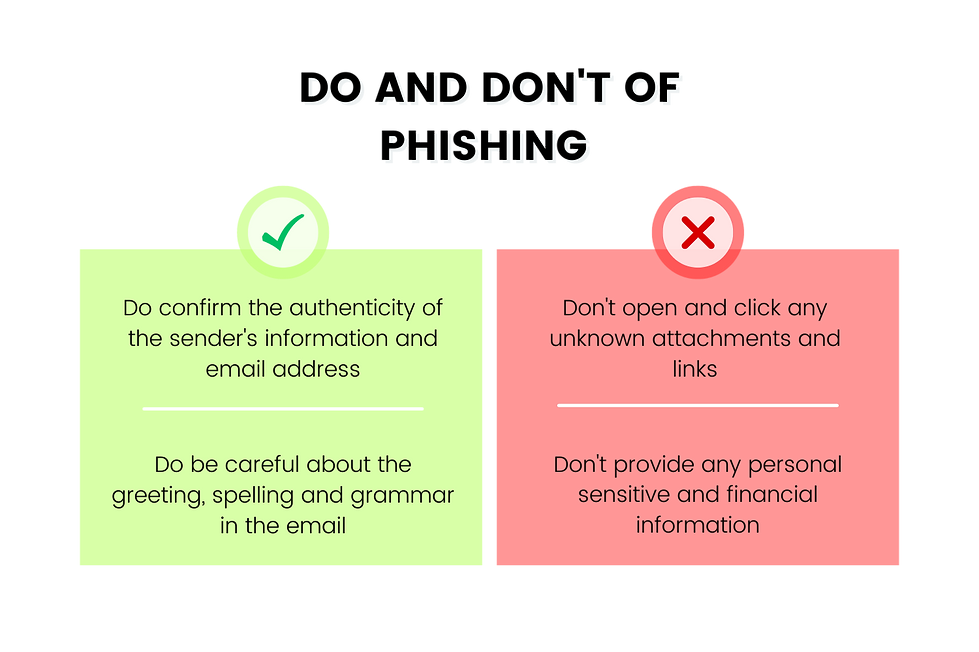
Do confirm the authenticity of the sender's information and email address
We must ensure that the address in any email matches the sender's information. This is because major firms frequently use email addresses that include the name of the corporation. If the address in the email does not match the sender's information, it is enough to prove that the email is fraudulent. In addition, we must conduct an online check to determine whether the email address and company name are legitimate.
-
Do be careful about the greeting, spelling and grammar in the email
We must ensure that the greetings in any text messages and emails we receive contain our names. In addition, we also need to check that the spelling and grammar are used correctly in the message. This is because incorrect names, spelling, and grammar reveal that the message is untrue and unreliable. Since phishers need to trick a large number of users quickly, they will intentionally blur the greeting and send the same content to the users in a massive and fast way to tempt them to take the bait.
-
Don't open and click any unknown attachments and links
We should avoid opening and clicking on any unknown attachments and links sent on social media, text messages, and instant messaging apps such as Facebook, SMS, WhatsApp, and others unless the connection and attachment are authentic. Also, we need to ensure that the link's URL begins with https:// rather than http://. This can be a way of spreading phishing tactics and malware, which can lead to a serious risk of personal information leakage and device infection. In addition, some websites have pop-up messages or advertisements asking us to click on specific files and links, which can lead to hacking, impersonation, and disclosure of personal information.
-
Don't provide any personal sensitive and financial information
We should refuse to provide personal sensitive information as well as financial information to others as it can lead to personal identity leakage, hacking, and financial loss. For example, when we receive a call claiming that you have committed a traffic violation in a certain area on a certain day of a certain month and you are required to immediately provide your personal information such as your IC number, or pay a fine to a certain account, but a visit to www.myeg.my reveals that you don't have any ticket for traffic violation. At this point, we should immediately report this phone number and not provide any information.
.png)
-
Install an Anti-Phishing tool
Install an Anti-Phishing tool to catch phishing attempts quickly. For example, well-known anti-phishing tools are Cofense Inc., Avanan Inc., Ironscales, Barracuda Sentinel, and others. These anti-phishing tools can detect suspicious emails through Artificial Intelligence (AI) and Machine Learning (ML) to isolate phishing emails from spam. In addition, anti-phishing tools recognize malicious websites and effectively prevent users from visiting websites that contain phishing content. As a result, installing anti-phishing tools successfully protects users' and organizations' personal information and defends against phishing attacks.
-
Check our credit frequently
If you haven't checked your accounts and credit cards for a while, beware of being used illegally. We must make it a habit to check our credit and change our passwords regularly to prevent our banks and credit cards from being used in phishing scams without our knowledge. For instance, phishing attackers use our identity and name to apply for a credit card account or borrow money for a loan like a bank. Therefore, we can regularly check our bank account spending and personal loan credit. In addition to minimizing phishing attacks, regular credit checks are also effective in preventing identity theft, property loss and maintaining a good credit score.
-
Keep our browser and system up to date
Keep our browser and system up to date which includes anti-phishing tools, anti-virus software, firewalls, and others. Since browsers and systems are often attacked by phishing, we must update anti-phishing tools regularly to quickly detect the latest phishing emails, websites, and methods. In addition, keeping browsers and systems updated fixes known security vulnerabilities and prevents phishing attackers from stealing personal information and planting malicious virus software. This greatly enhances phishing threat detection capabilities and browser and system security.
-
Utilize strong passwords and two-factor authentication
A strong password must have an assortment of large and small letters, numbers, and symbols, and the number of passwords must be between a minimum of 12 and 14. In addition, we must avoid using names and words or numbers that contain personal information such as dates of birth when creating passwords. Creating unique, difficult-to-crack passwords minimizes the danger of getting phished. Next, we add two-factor authentication to the account, which is more secure than simply signing in with a password because it needs two methods of access, such as a fingerprint, a one-time verification code, and an email address. Even if the password is compromised, we have a second verification to log in to the account and replace the compromised password.
.png)
Cyberthreat Impacts
Individuals
Financial Loss : Victims of phishing scams frequently suffer substantial financial losses. This is because personnel who fall for a phishing message from a person or organization end up providing the attacker with critical personal data, including credit card numbers, bank account numbers, passwords, personal Identification Numbers (PINs), or One-Time Passwords (OTPs). The phisher may utilize personal data to carry out unexpected and unauthorized transactions that result in significant financial loss from actions like direct theft or fraudulent charges.
Identity Theft : Identity theft is also one of the consequences of phishing cyberattacks. The attackers might create social media accounts in the victim's name on sites like Facebook or WhatsApp, or they might use the stolen personal information to attempt fraud against the victim's friends or family. These acts could happen quickly, harming one's reputation.
Loss of privacy : Cyberattacks may additionally disturb a person's privacy by disclosing private information to unapproved parties, resulting in a loss of privacy and the accidental leakage of personal information, and making a person more at risk for scams or other attacks.
Communities
Loss of Turst : The spread of private or sensitive data or targeted misinformation can cause people to lose trust in digital technology and organizations, foster discord and division within the community, and encourage the spread of false information. For example, misinformation on social media has the potential to exacerbate the discussion, conflict, tension, and a general sense of unease and distrust between different groups or individuals in the community.
Lack of Resources : For instance, if a healthcare provider's systems are compromised, it may lead to a temporary cessation of essential medical services, which would seriously disrupt and shortchange patients who depend on timely care. This is because the hospital will handle private health and financial data, which is very appealing to hackers, and staff members might not have received enough cybersecurity training, leaving them more vulnerable to phishing schemes.
Organisations
Intellectual Property (IP) Theft : Phishing attacks on organizations may lead to in IP theft, including trade secrets, copyrights, and trademarks. Theft of confidential company data can seriously negatively affect a firm's competitive edge, and position in the market, and result in monetary losses and market share loss.
Loss of Reputation : Company's reputation may suffer long-term harm due to phishing attempts. This is partially because once attackers get access to your networks, they can send out spam or other malicious emails purporting to be your company. Furthermore, the effects of a phishing assault can spread quickly in a society like wildfire. When you disclose a data breach, the public's memory of the incident can be clouded for years, making it difficult to restore your reputation. And they will continue to harm the public's perception of your brand for as long as they persist.
Loss of Productivity : Any cyberattack causes delays in service delivery, lost productivity, and other important operations disruptions for enterprises. When a cyberattack occurs, almost all businesses are forced to halt some or all of their operations to minimize the loss until the attack is resolved, which can take hours or even days depending on the circumstances.
Country
Unstable economies : Cyberattacks on major financial institutions across the country, like stock exchanges and banks, have the potential to disrupt business dealings, result in significant financial losses, erode public trust in financial systems, and undermine investor confidence. Then, there will be a disruption and decreased strain on the national economy.
Public Safety : According to CEI News, a cyberattack on a government agency raises more concerns than any other because of the sheer amount of data that could be lost. This data includes military and national security information that terrorist groups could exploit, as well as personal information about citizens that could be sold on the dark web. The national defense capabilities are put in peril if such military systems are compromised or stolen, then could put millions of people in grave danger.
Political issues : This is because scammers always pose as representatives of the government, leaking sensitive data or disseminating false information in the process. This distorts political discourse, shapes public opinion, widens political rifts, and erodes public confidence in respectable government institutions.
Global
International Relations : If a nation launches an attack against another, tensions in international relations will arise and disputes will ensue. Belarusian state-sponsored hackers began an espionage campaign against Ukraine's Ministry of Defense and a Ukrainian military base, according to actual important instances documented by the Center for Strategic & International Studies (CSIS). Phishing emails with drone photo files and a malicious Microsoft Excel spreadsheet were sent to the targets by the attackers. Tensions with other nations that back Ukraine as well as between Belarus and Ukraine were made worse by the cyberattack. Following this incident, Belarus was subject to public criticism and international censure from multiple countries, which resulted in the country being diplomatically isolated and subject to continuous sanctions.
Legislative, Regulatory and Policy Problems : Countries will frequently update their legislative, regulatory, and policy frameworks in the wake of a big hack to strengthen global cybersecurity. This entails strengthening data protection legislation, developing policies to handle emerging threats, and defining more precise standards for incident response and reporting. To ensure enhanced collaboration in the fight against cyber threats, nations may also choose to intensify their cooperation on global cybersecurity standards and procedures. There might also be a push for more investment in cybersecurity infrastructure and training, as well as stricter enforcement procedures and sanctions for noncompliance.